Introduction
New to identity verification in Nigeria? Start with our complete developer guide.
Fintech founders and engineers in Nigeria: verify every customer at signup, at the moments that carry risk and when they lose access, without storing a single face and without a bill that grows with every signup. This guide shows where identity verification belongs in a fintech app, what to build at each point and what to leave to other systems.
For the full picture of the flow, start with the complete developer guide. The product view for fintechs is on the fintech solutions page.
Want to see it work? Create a free account and run the full flow in the sandbox: no card, no business verification, all three products. Start free
01Why fintech is different
A fintech holds money, and money attracts people who are not who they claim to be. Three things make verification harder for you than for most apps.
- Your users are remote. Nobody walks into a branch. The camera is the branch.
- The cost of a wrong decision is direct. A fake account becomes a defaulted loan, a mule account or a chargeback.
- Regulators ask for evidence. You must show how you knew who the customer was, not just that you asked.
OTP by SMS does not close this gap. A SIM swap hands the attacker the code, and the code proves only that someone holds the number. We cover that in more detail in the use cases.
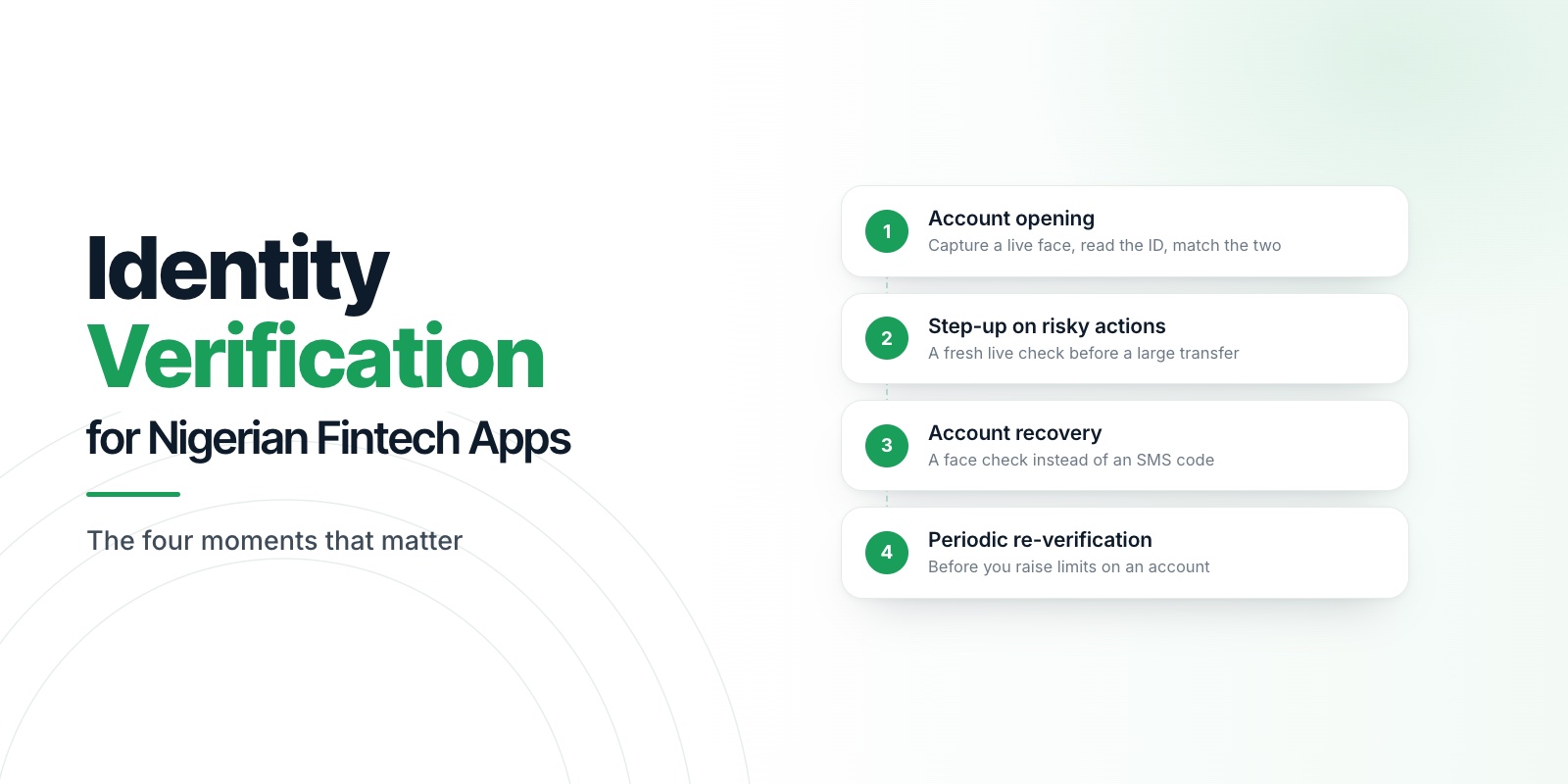
02The four moments that matter
1. Account opening
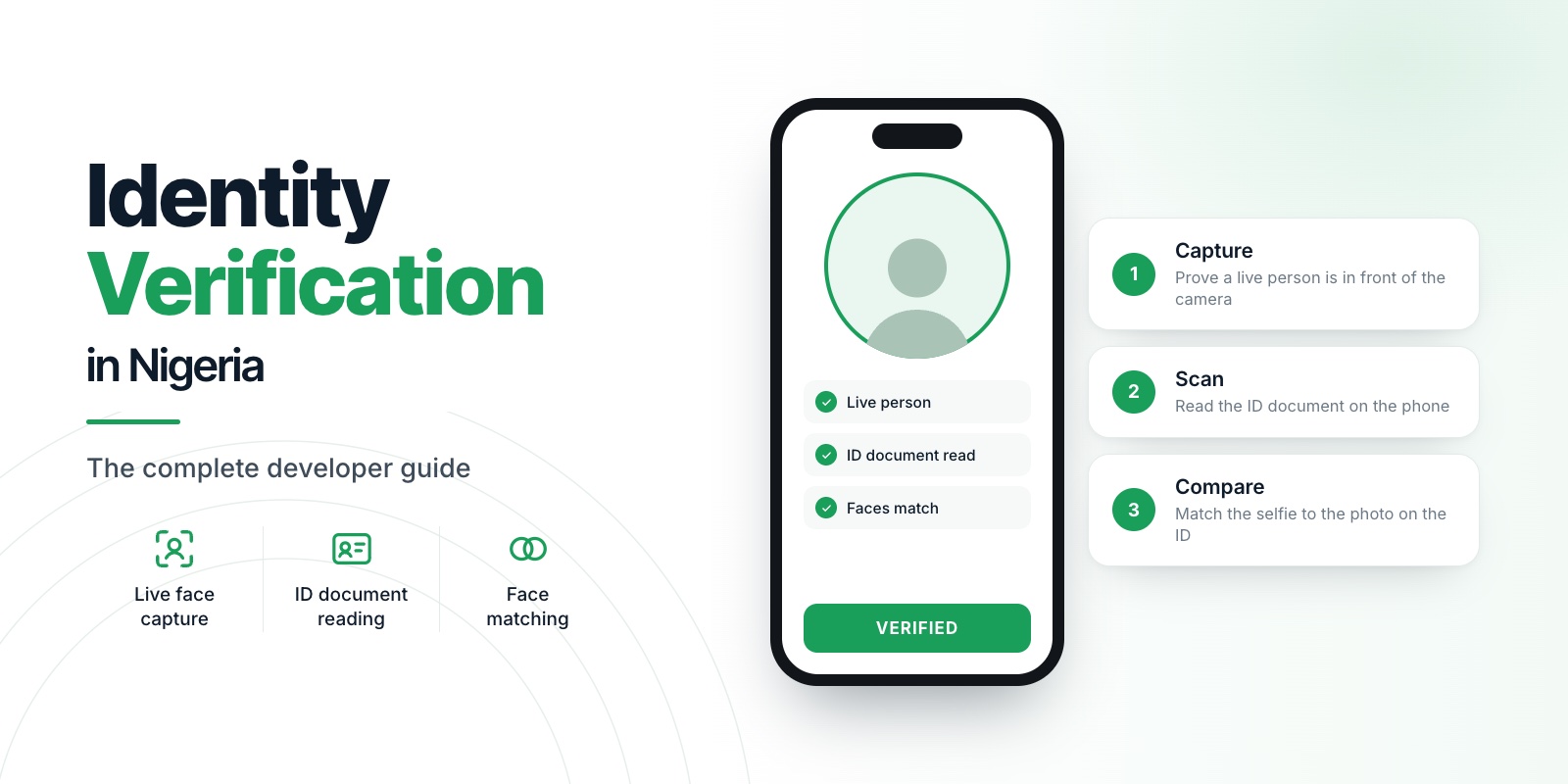
This is the full flow: capture a live face, read the ID, match the two.
- Capture a live face with liveness. The user cannot pass with a photo of a photo.
- Scan the document. Get named, checked fields and the face photo on the ID.
- Compare the live face with the ID photo from your backend. Use the
kyc_onboardingpreset, which allows for old, small ID photos. - Decide on your server from the signed capture result and the comparison, and record the evidence.
2. Step-up on risky actions
A login is not a transfer. For a large transfer, a new payee or a change of phone, ask for a fresh live capture and compare it with the face from onboarding. Use the stricter liveness_check preset, because both images are recent selfies.
3. Account recovery
"I lost my phone" is the favourite door for attackers. Replace the SMS code with a live face check against the saved onboarding face, and send low-confidence results to manual review.
4. Periodic re-verification
For dormant accounts or limit increases, run the same capture and compare flow before you raise limits.
03What your backend must do
The phone is not a trusted place to decide. Your server should:
- issue a one-time nonce per session,
- verify the signed capture result through Veris, which also rejects replays,
- request the face comparison itself, with the key kept on the server,
- store the decision, the score, the preset used and the time, not the images.
The patterns are in Document Verification API Design and Face Matching API Explained.
04What verification does not do for a fintech
Be clear about the edges, so nobody assumes more than the flow gives you.
- No BVN or NIN database lookup. Veris reads the document and compares faces. If the CBN requirements for your licence call for retrieving BVN or NIN data from the issuing systems, that is a separate service that runs next to this flow. See CBN KYC Requirements: The 3-Tier Framework.
- No authenticity forensics. Scan reads what is printed. It does not judge whether a card is genuine.
- No transaction monitoring or sanctions screening. Those belong to your AML systems. See CBN AML Baseline Standards for Fintech Developers.
05What waiting costs you
Every week a fintech onboards without a live check, three costs build up:
- accounts opened with stolen or borrowed identities,
- staff time spent reviewing selfies and ID photos by hand,
- an answer you cannot give when a partner bank or regulator asks how you verified a customer.
Fixing it later also means re-verifying users who are already in, which is harder than checking them at the door.
06What you get with Veris
- Three products on one key: Capture, Scan and Compare, so you do not stitch three vendors together.
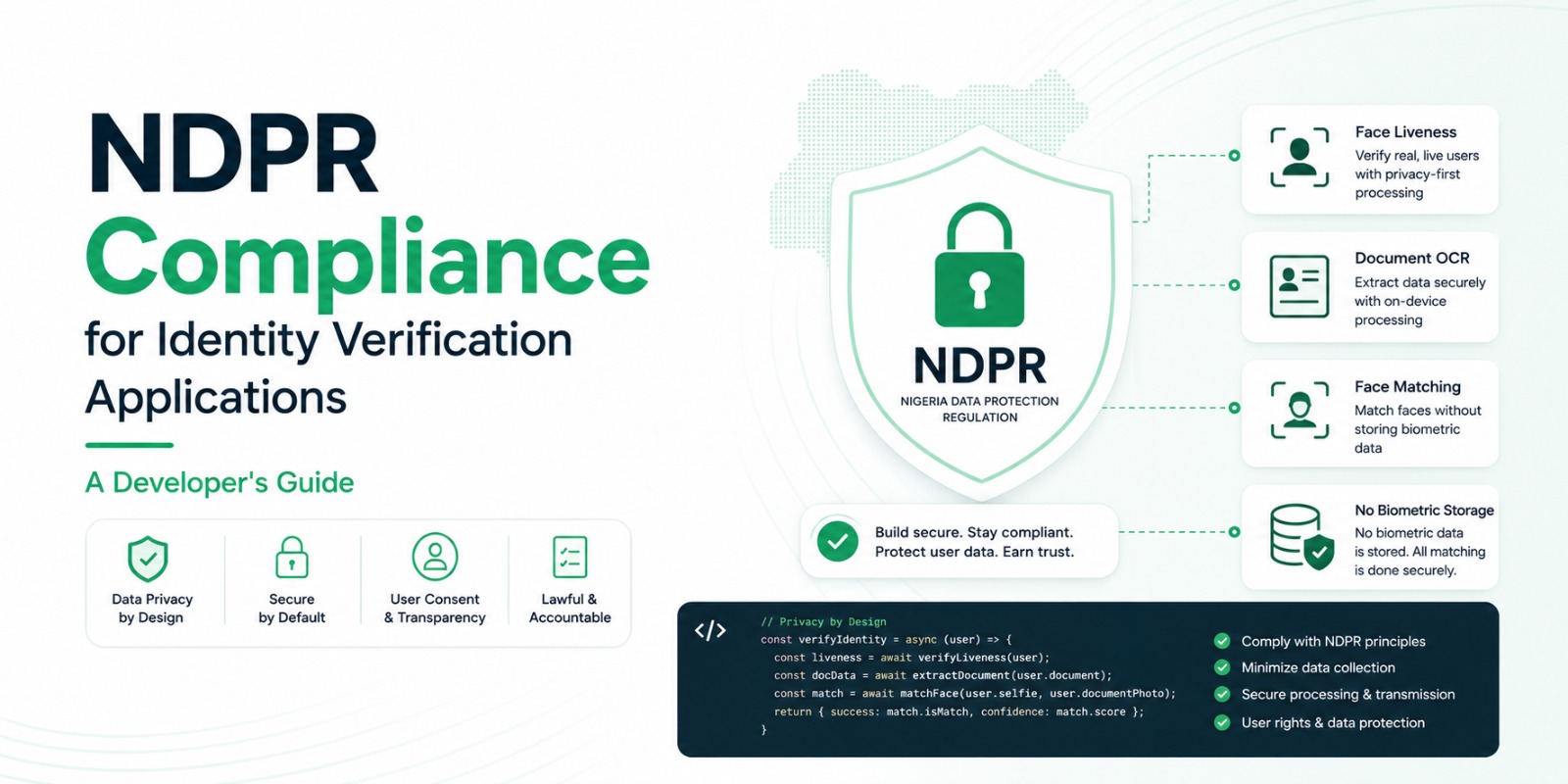
- No images stored by Veris. Capture and Scan run on the phone. Images sent to Compare are processed in memory and deleted after every request.
- A flat bill with a ceiling. Capture and Scan are unlimited from the Launch plan at $19 a month. Compare has an included amount and a fixed ceiling, so the most Launch can cost in a month is $49. See the cost model.
- Free to try and free to go live. The sandbox has all three products, and the Spark plan lets you launch at low volume without paying.
07The doubts you probably have
"We already verify BVN." Good. Keep it. BVN confirms a record exists. A live face check and a document read confirm the person in front of the camera matches that record and is really present. They answer different questions.
"Will it slow down signup?" It is one guided session. Capture checks the frame before it captures, and Scan waits for a sharp image, so fewer users fail and retry. Read Designing a Frictionless KYC Onboarding Flow.
"Our compliance team will ask where the face data goes." It stays on the phone, or is deleted after one comparison. That is the whole answer, and it is a short one.
"What if it does not suit us?" Test it in the sandbox first. If your first paid month is not right, you can get it back within 14 days by emailing [email protected] (once per account, Compare extras excluded).
08Your next step
Pick the moment that hurts most: signup fraud, risky transfers or account recovery. Build that one flow in the sandbox this week, then add the others.
Create your free Veris account · Free to start · no card · all three products. Prefer to talk first? Talk to the team.
09FAQ
What does a Nigerian fintech need for identity verification?
At minimum: a live face check, a read of the identity document and a match between the two, decided on your server with an audit record. Add database checks, sanctions screening and transaction monitoring as your regulator and partners require.
Can I use identity verification to replace SMS OTP?
For high-risk moments such as recovery and large transfers, a live face check is stronger evidence than an SMS code, because a SIM swap defeats the code but not the face check. Many teams keep OTP for low-risk steps and add the face check where the risk is higher.
Does Veris store customer face images?
No. Capture and Scan run on the user's phone, and Compare deletes the images it receives after every request.
Which documents work for fintech onboarding?
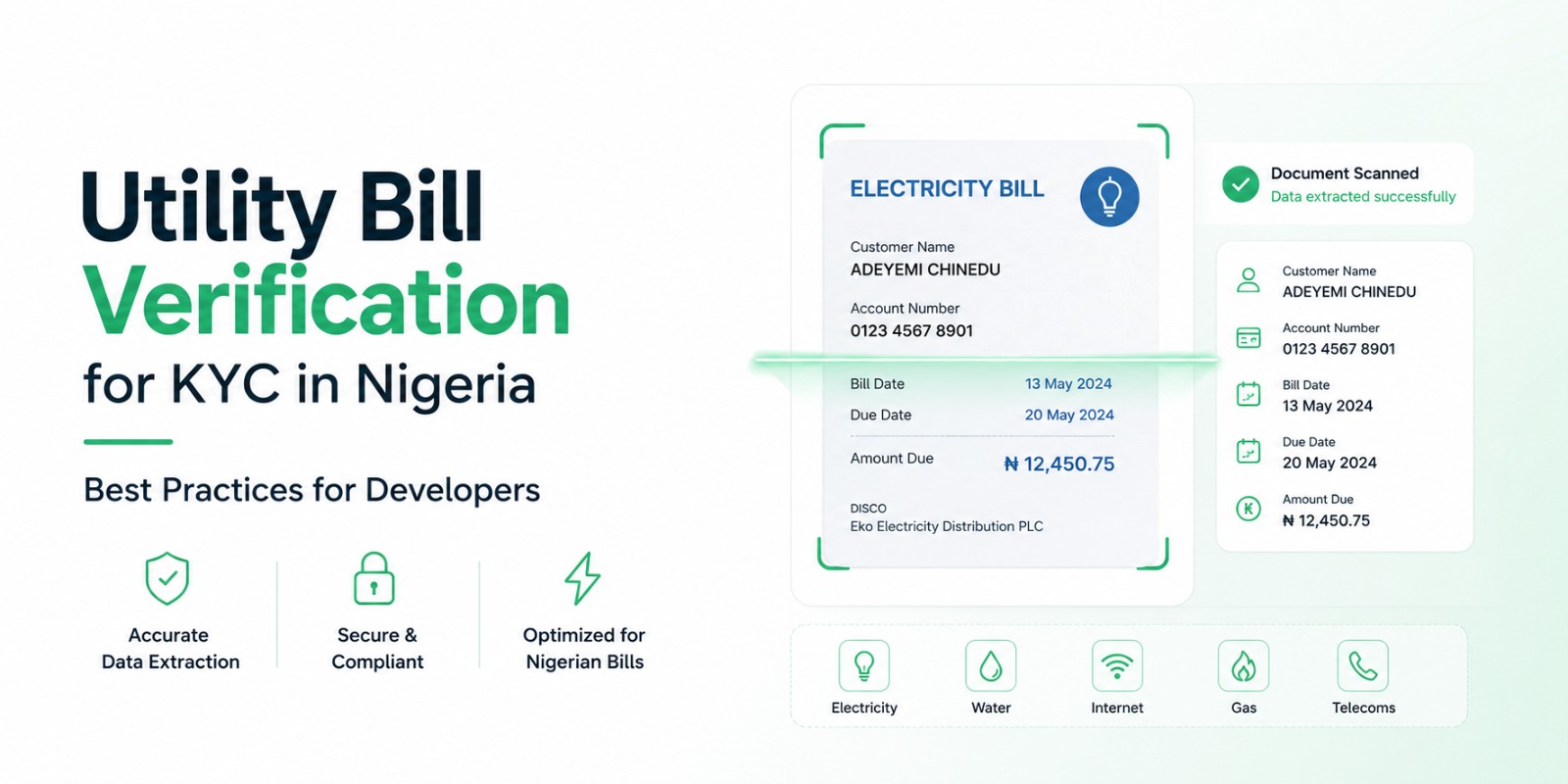
NIN slips, national ID cards, driver's licences, international passports and voter's cards, plus proof-of-address documents. See Nigerian ID Verification.