Introduction
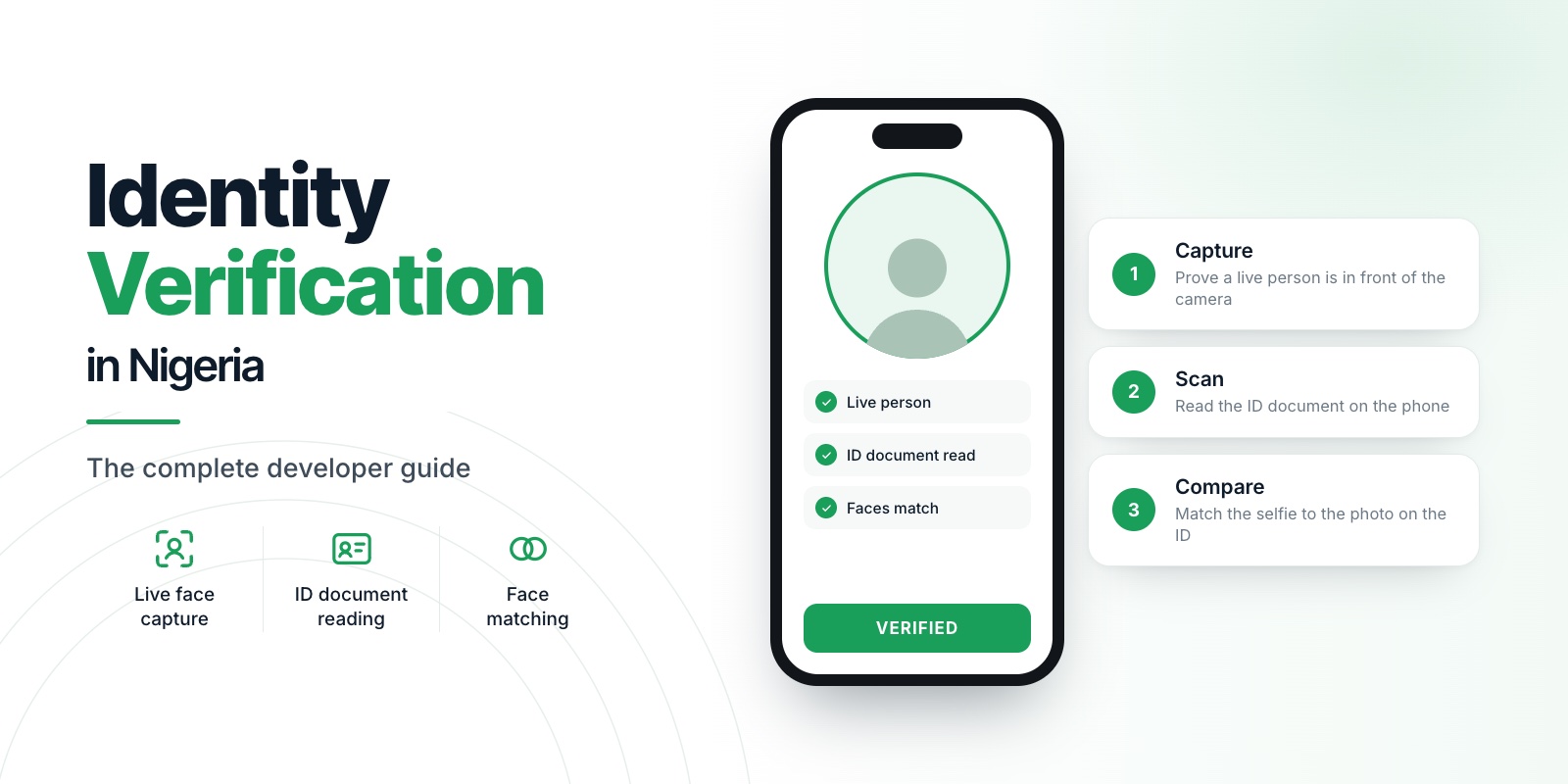
New to identity verification in Nigeria? Start with our complete developer guide.
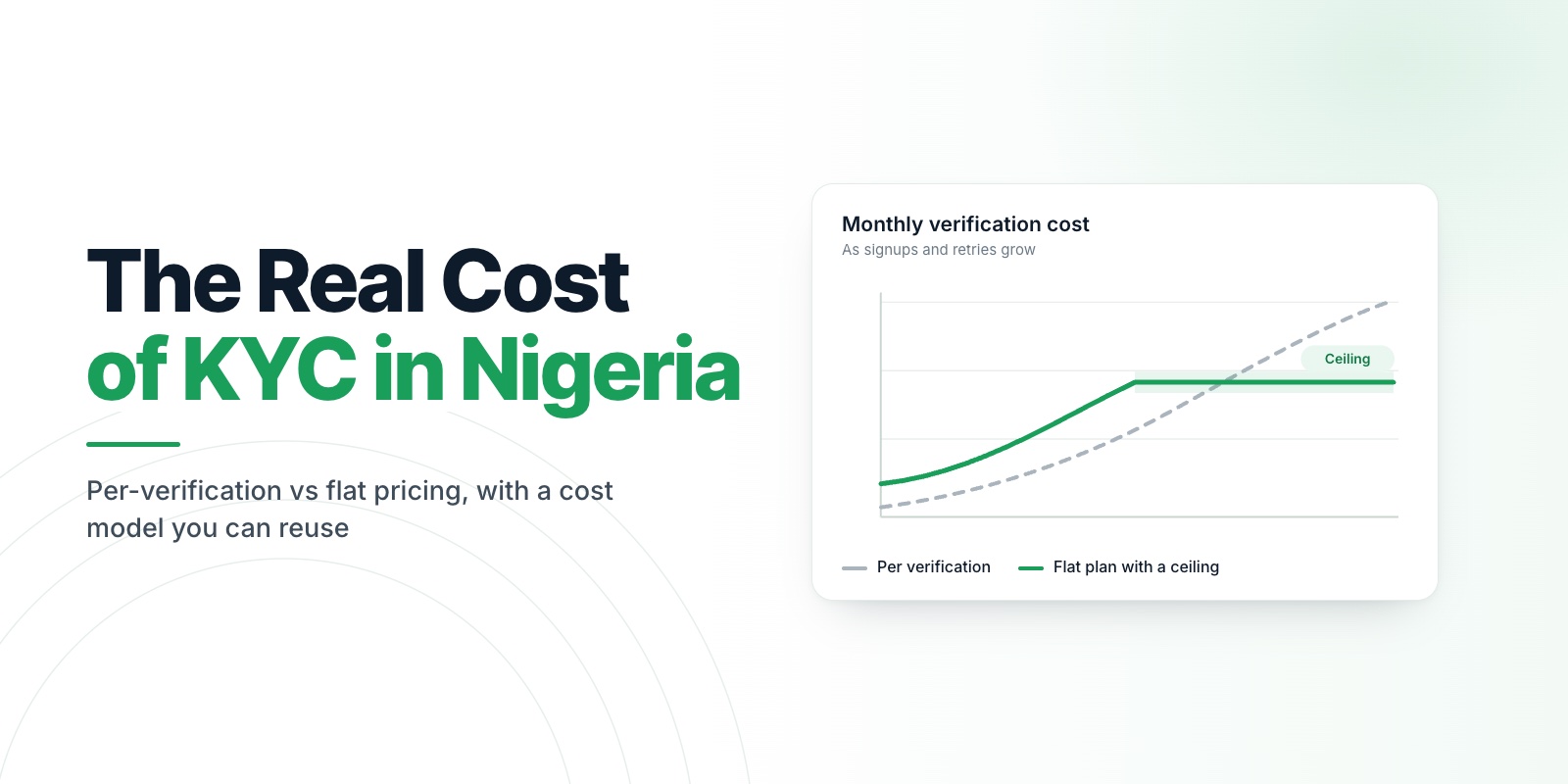
Your KYC bill should not quadruple because a bot found your signup page. This article models what per-verification pricing really costs a Nigerian startup as signups, retries and fraud grow, and shows the flat plan that stops the bill at a number you can plan for.
Want to see your own numbers? Use the pricing page to pick a plan and see the most you could ever pay, or start free and test before you spend anything.
For the non-price side of the decision, read How to Choose an Identity Verification Provider in Nigeria.
01The number you cannot predict
A KYC bill is price multiplied by volume, and volume is not "new customers". It is every attempt:
- Real users who fail once and retry because of poor light or a blurry ID.
- Users who start and abandon, then come back next week.
- Marketing spikes, a referral campaign or a promo that doubles signups for a month.
- Bots and fraud rings that submit hundreds of attempts to find the weak spot.
If you are billed per verification, every one of those is a line on the invoice. If you are billed on a flat plan, only the part that is metered grows.
02A simple model you can reuse
We will use a made-up price to show the shape. It is not any provider's real price. Replace it with a quote you have received.
Assume a per-verification provider charges $0.30 for a bundle of liveness, document read and face match, and bills every attempt.
- Normal month: 5,000 signups, 1.4 attempts each on average (some retries) is 7,000 billed attempts, so $2,100.
- Campaign month: signups double to 10,000, 1.4 attempts each is 14,000 attempts, so $4,200.
- Bot month: 5,000 genuine signups plus 20,000 bot attempts is 27,000 attempts, so $8,100.
The price never changed. The bill nearly quadrupled. The cost of fraud, which you did not choose to incur, landed directly on your budget.
The question to ask any provider is: are retries, failures and abandoned attempts billed, and is there a ceiling?
03How a flat plan with a ceiling behaves
Veris prices in dollars on flat monthly plans and you pay in naira at the day's rate. Capture and Scan are unlimited from the Launch plan upwards, with no fee per check. Compare, the face match, is the only part that grows with use, and it has an included amount and a ceiling.
At the time of writing:
- Launch, $19 a month: 1,500 comparisons included, then $0.03 each, with extras stopping at $30. The most you can pay in a month is $49.
- Scale, $39 a month: 10,000 comparisons included, then $0.02 each, with extras stopping at $50. The most you can pay is $89.
- Pro, $79 a month: 30,000 comparisons included, then $0.01 each, with extras stopping at $80. The most you can pay is $159.
Re-run the three months above on Scale:
- Normal month (7,000 attempts): all within the 10,000 included comparisons. $39.
- Campaign month (14,000 attempts): 4,000 over. At $0.02 that is $80, but extras stop at $50, so the bill is $89 at most.
- Bot month (27,000 attempts): far past the ceiling. The bill is still $89 at most.
Two things make this model smaller than it looks. First, only comparisons that succeed count, so a bad image or "no face found" costs nothing. Second, retries of the capture step are not metered at all, because Capture is flat.
04What happens at the ceiling
A ceiling protects your wallet, not your funnel, so decide what you want to happen when you hit it.
- Wallet off (the default): comparisons pause until your next billing cycle. Your plan is not suspended and the rest of the SDK keeps working.
- Wallet on: comparisons continue from prepaid credit at a flat price per comparison, which you can see in your dashboard, with an optional spending limit per cycle.
Either way, you pick the failure mode in advance instead of discovering it on an invoice.
05The costs that are not on the invoice
Price per check is only part of the cost.
- Lost signups. If your capture step is slow or confusing, users leave. The Hidden Cost of KYC puts numbers on why this usually outweighs the verification fee.
- Engineering time. A flow that needs a separate integration for each step takes longer to build and to maintain.
- Storage and compliance. If you hold face images, you carry the cost of securing them and the risk of losing them. Not storing them removes the cost. See NDPR Compliance for Identity Verification.
- Manual review. A cheap check with a high false-reject rate sends work to a human team.
- Currency. Most plans are quoted in dollars. A plan paid in naira at checkout, with the exact amount shown before you confirm, removes a surprise.
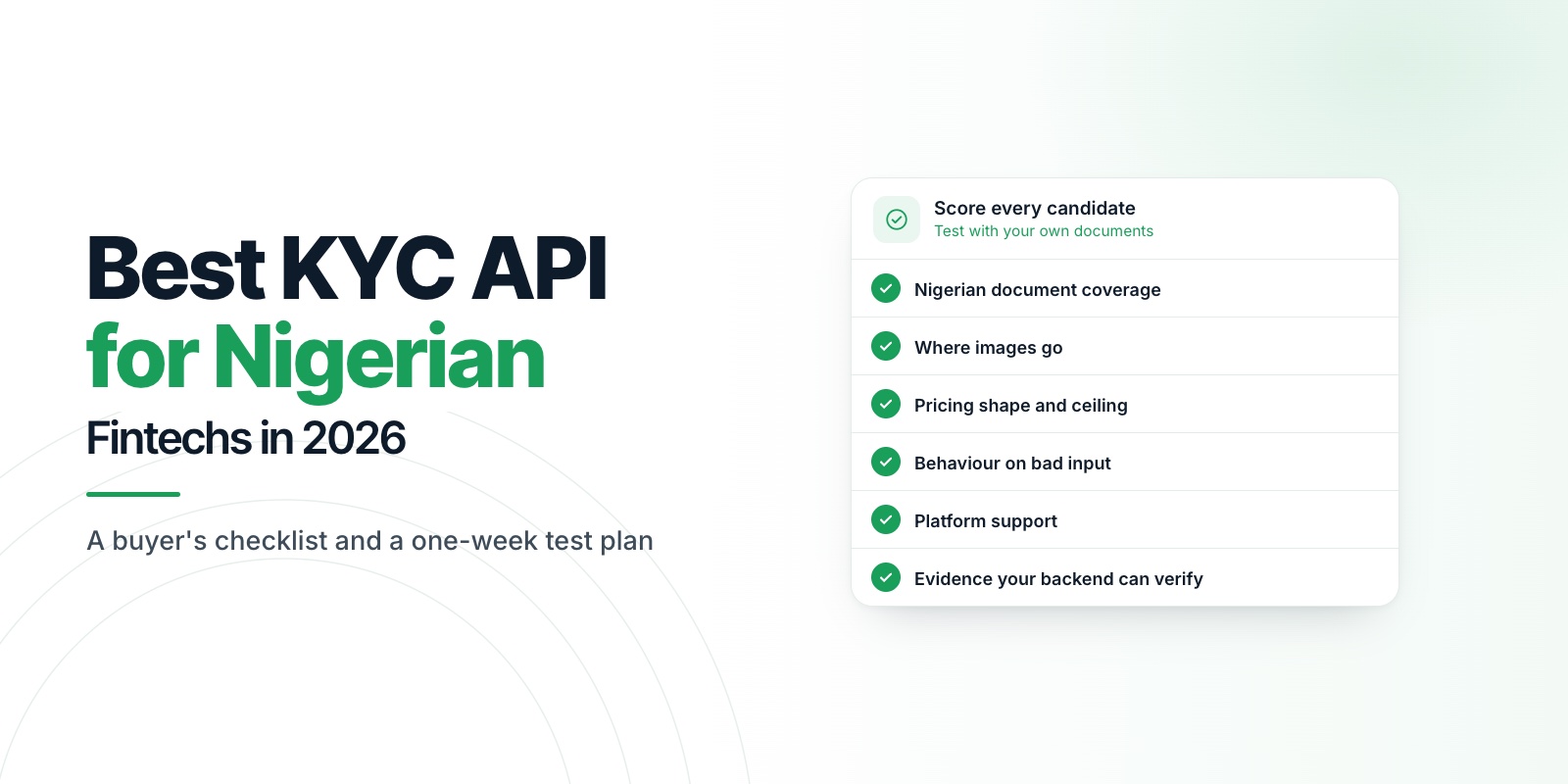
06A checklist for comparing quotes
Ask every provider, in writing:
- Is the price per attempt or per successful verification?
- Are retries, failures and abandoned sessions billed?
- Is there a ceiling on monthly spend?
- What is included in the price: liveness, document read, face match?
- Are images stored, and for how long?
- What happens when I run out of included volume?
- What is the price at 10 times my current volume?
- How do I pay, and in which currency?
07The honest summary
Per-verification pricing is fine when volume is low and stable. It is risky when volume is growing, seasonal or exposed to bots. A flat plan with a visible ceiling gives you a number you can put in a budget. You can compare your own numbers on the pricing page and read the wider guide in Identity Verification in Nigeria.
08What waiting costs you
If you are on a per-check price today, the cost of not switching is not the price per check. It is the next campaign, the next bot wave and the next retry spike, each billed at full price with no ceiling.
If you have no verification yet, the cost is the fraud you are absorbing and the staff time you are spending, and neither shows up on a vendor invoice, so neither gets noticed.
09The decision in three lines
- Capture and Scan are flat. From the Launch plan at $19 a month they are unlimited, with no fee per check however many people sign up.
- Compare is the only part that grows, and it has a ceiling. The most Launch can cost in a month is $49, Scale $89 and Pro $159.
- You choose what happens at the ceiling. Comparisons pause until the next cycle, or continue from prepaid credit if you turn the wallet on.
10The doubts you probably have
"Flat plans might cost more than we need." Start free. The sandbox is free, and the free Spark plan lets you go live at low volume. Move up only when your volume says you should.
"We bill in naira and the price is in dollars." You pay in naira at the day's rate and see the exact amount before you confirm. No surprise at the bank.
"What if we hit the ceiling mid-month?" Then comparisons pause, or continue from your wallet if you turned it on. Either way, your plan stays active and the rest of the SDK keeps working. You pick the behaviour in advance.
"What if it is not right for us?" Cancel from the dashboard at any time. If your first paid month is not right, you can get it back within 14 days by emailing [email protected] (once per account, Compare extras excluded).
11Your next step
Take last month's real attempt count, including retries. Put it next to the plan numbers above. If the flat plan wins on your own figures, you have your answer, and the sandbox lets you test the product before you pay.
Create your free Veris account · Free to start · no card. Or see the plans.
12FAQ
How much does KYC cost in Nigeria?
It depends on the provider and what is included. Compare the structure as well as the headline price: whether retries are billed, whether there is a spending ceiling and what is bundled. Use the checklist above on every quote.
Is flat pricing cheaper than per-verification pricing?
At low, stable volume the two can be close. As volume grows, or when retries and bots inflate it, a flat plan with a ceiling usually stays predictable while a per-attempt bill keeps climbing.
Do failed face comparisons count against my Veris quota?
No. Only a comparison that succeeds counts. A missing face, a bad image or a temporary error is free.
Can I try Veris without paying?
Yes. The sandbox includes all three products with no card, and the Spark plan is free for small launches.