It was 11 p.m. and Tunde, a CTO building a digital lending platform, was staring at a deadline he couldn’t ignore.
His company had just secured regulatory approval (CBN). Now comes the real pressure: full KYC compliance before the next audit cycle.
He had two options:
Build everything from scratch and risk delays
Integrate an existing system and move fast
He chose speed.
Within two days, his team had a working KYC flow running in staging.
No bloated contracts. No fragile custom pipelines.
Just integration.
This is the exact approach.
Build vs Integrate
Building KYC internally sounds straightforward until you break it down:
Camera handling across fragmented Android devices
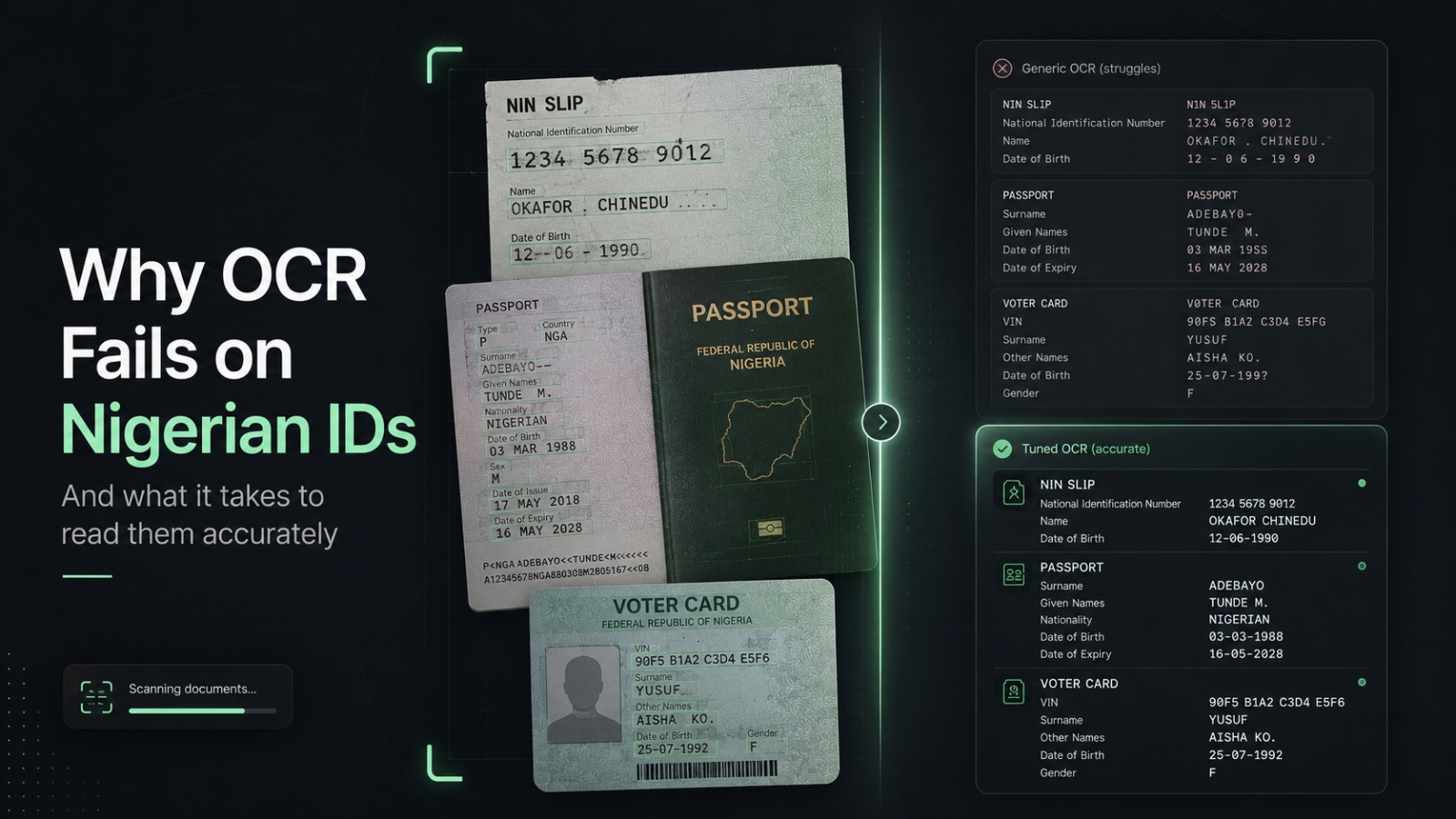
OCR that works on real Nigerian documents, not perfect samples
Liveness detection that doesn’t fail in low light
Face matching that is both fast and accurate
Audit logs that regulators actually accept
That is months of work.
And worse, it pulls your team away from your core product.
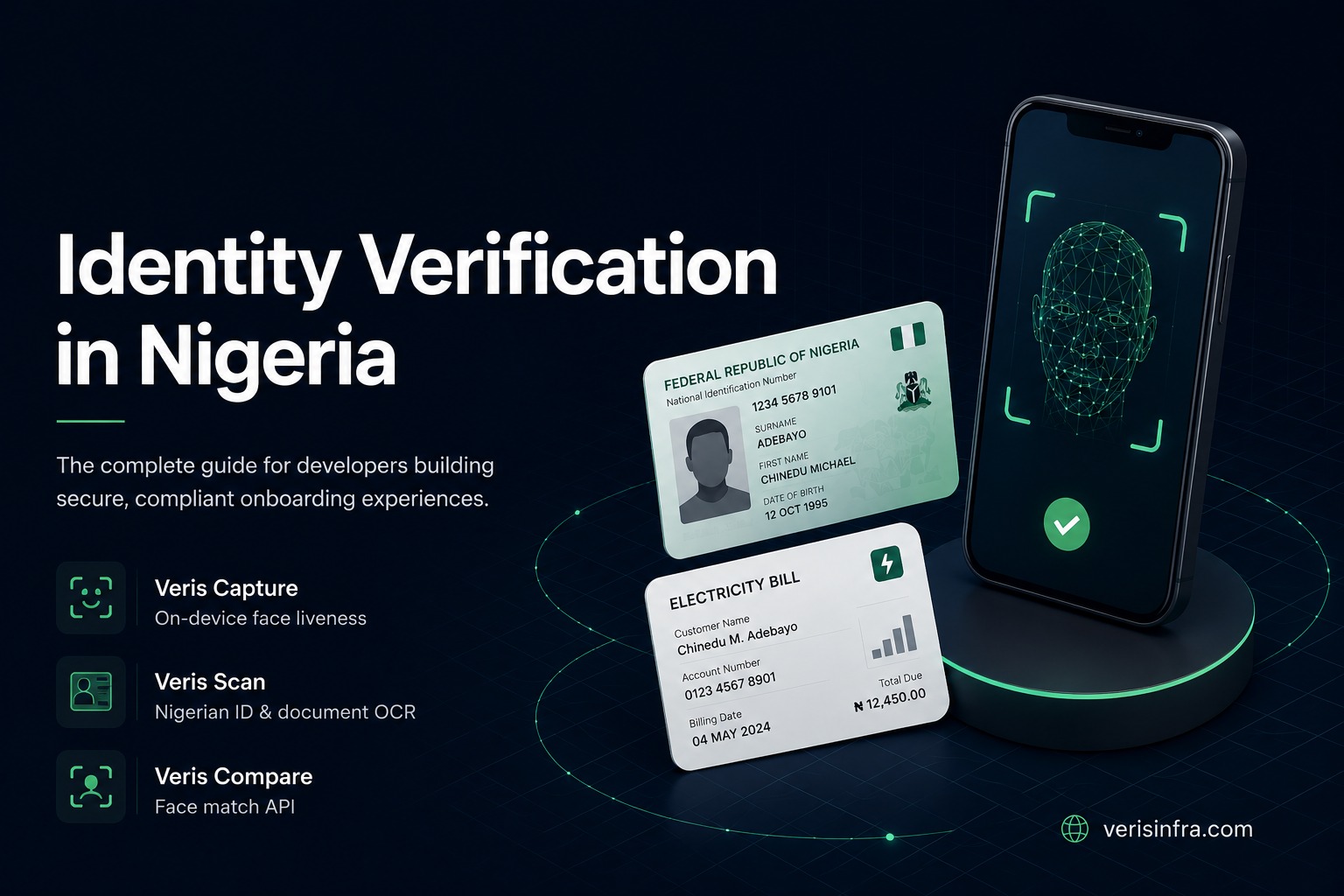
Veris compresses that entire stack into three components:
Capture
Scan
Compare
One API key. No infrastructure overhead.
The 4 - Step KYC Flow
Step 1: Scan the ID (Veris Scan)
Start by capturing the user’s identity document.
Instead of asking users to type their NIN, name, and date of birth, introducing errors and friction. You ask them to point their phone’s camera at their ID.
Veris Scan handles the rest:
Auto-detects the document type (NIN slip, Passport, Driver’s Licence, Voter’s Card, Utility Bill)
Extracts all relevant fields as structured JSON
Pulls out the face photo from the document for later matching
The OCR model is trained specifically on Nigerian documents. It reads crumpled, laminated, and faded IDs without complaint. No generic global tool will give you that accuracy.
Behind the scenes, Veris Scan also returns a cryptographically signed result, tamper-proof. Proof that the document was captured and verified.
Step 2: Capture Live Face (Veris Capture)
Now confirm the person holding the device is real.
Now that you have the ID, you need to confirm the person holding the device is the same person on the document, and that they’re a real, living human.
Veris Capture is a drop-in SDK that handles:
Passive liveness detection: No blinking, no head turns. The user just holds their face in frame. The technology quietly analyzes depth, texture, and micro-movements.
Auto-capture: The SDK automatically snaps the frame when the face is well-lit and centered.
12 quality checks: Blur, angle, occlusion, lighting, all evaluated in real time so users aren’t stuck in “retake” loops.
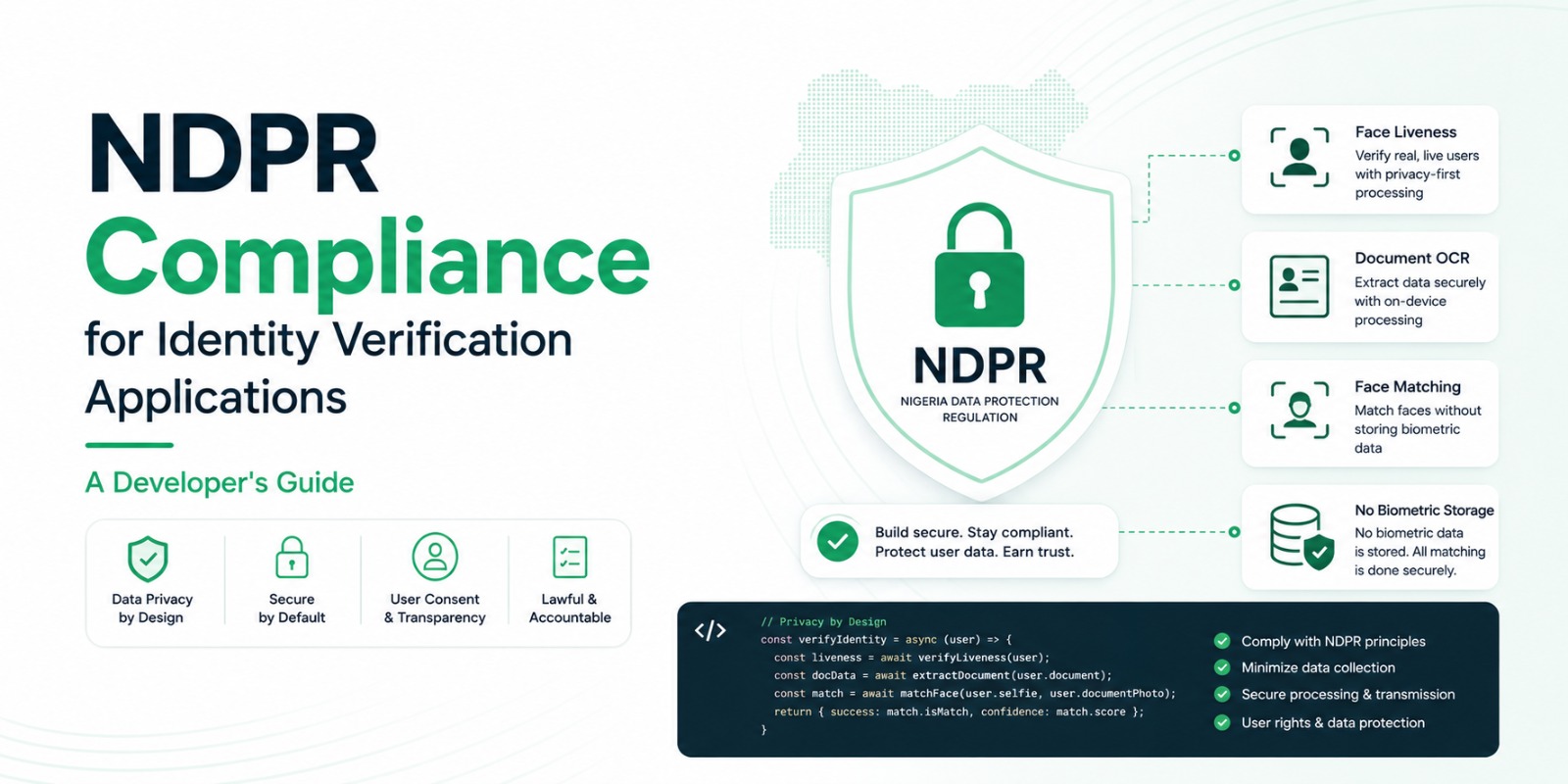
All processing happens on-device. The raw face image never leaves the phone. Only a mathematical face embedding is sent to your backend, and even that is discarded after comparison.
That’s NDPR compliance built directly into the architecture.
Step 3: Compare Faces (Veris Compare)
Now you have two images (or more precisely, two templates): one from the ID, one from the live selfie. You need to know if they match.
Your backend sends one POST request to the Veris Compare API:
Returns a similarity score (0-100)
You set the threshold that matches your risk appetite
The result is cryptographically signed, giving you a tamper-proof audit record
The entire comparison happens in milliseconds. And crucially, Veris does not store raw biometric images on its servers. The comparison runs on templates, and those templates are discarded immediately after the response is returned.
Just a decision you can trust.
Step 4: You’re Done
At this point, your system has:
Verified identity data
Proof of human presence
Face match confirmation
Signed audit trail
That’s a complete KYC pipeline.
No extra layers. No hidden complexity.
What This Looks Like in Practice
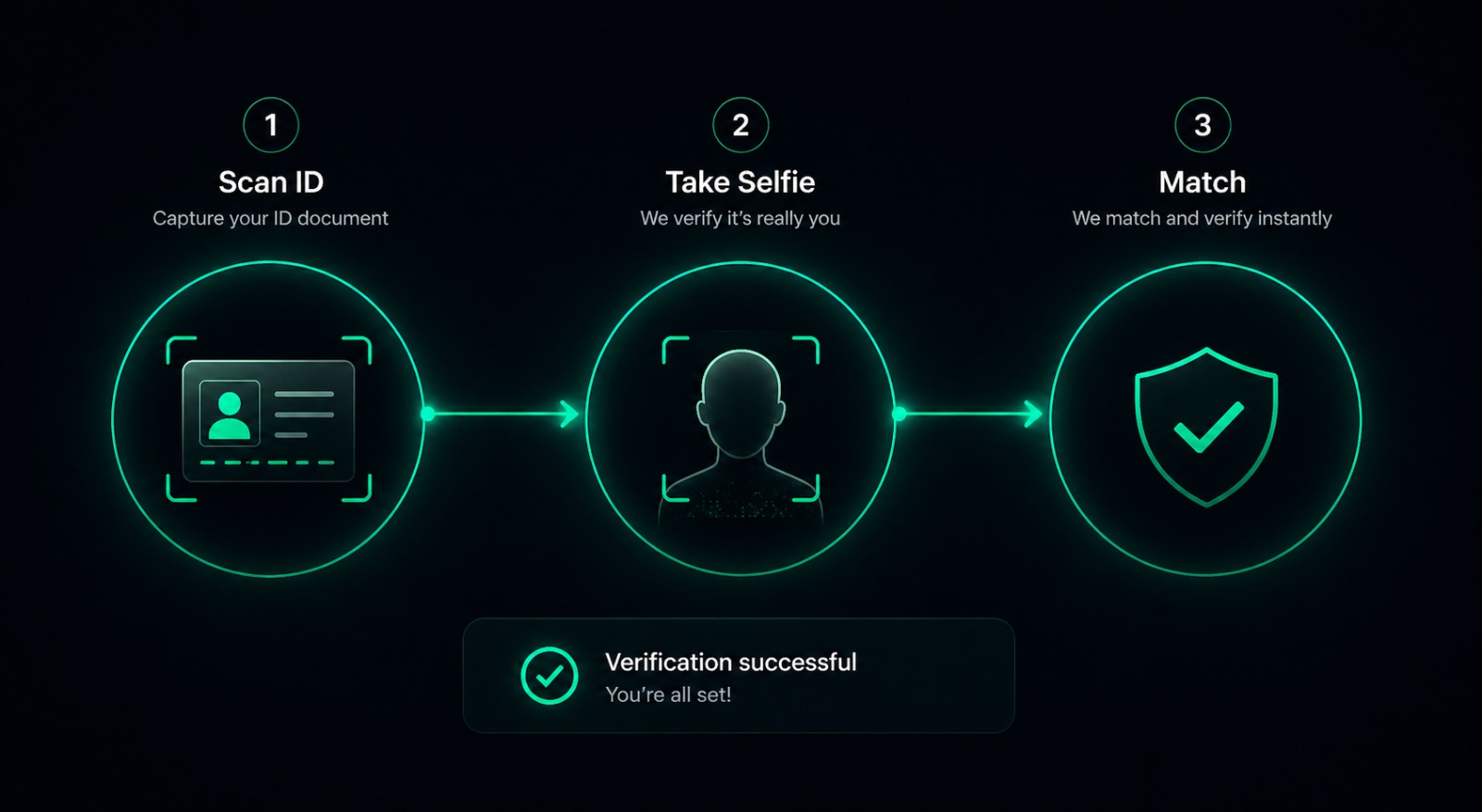
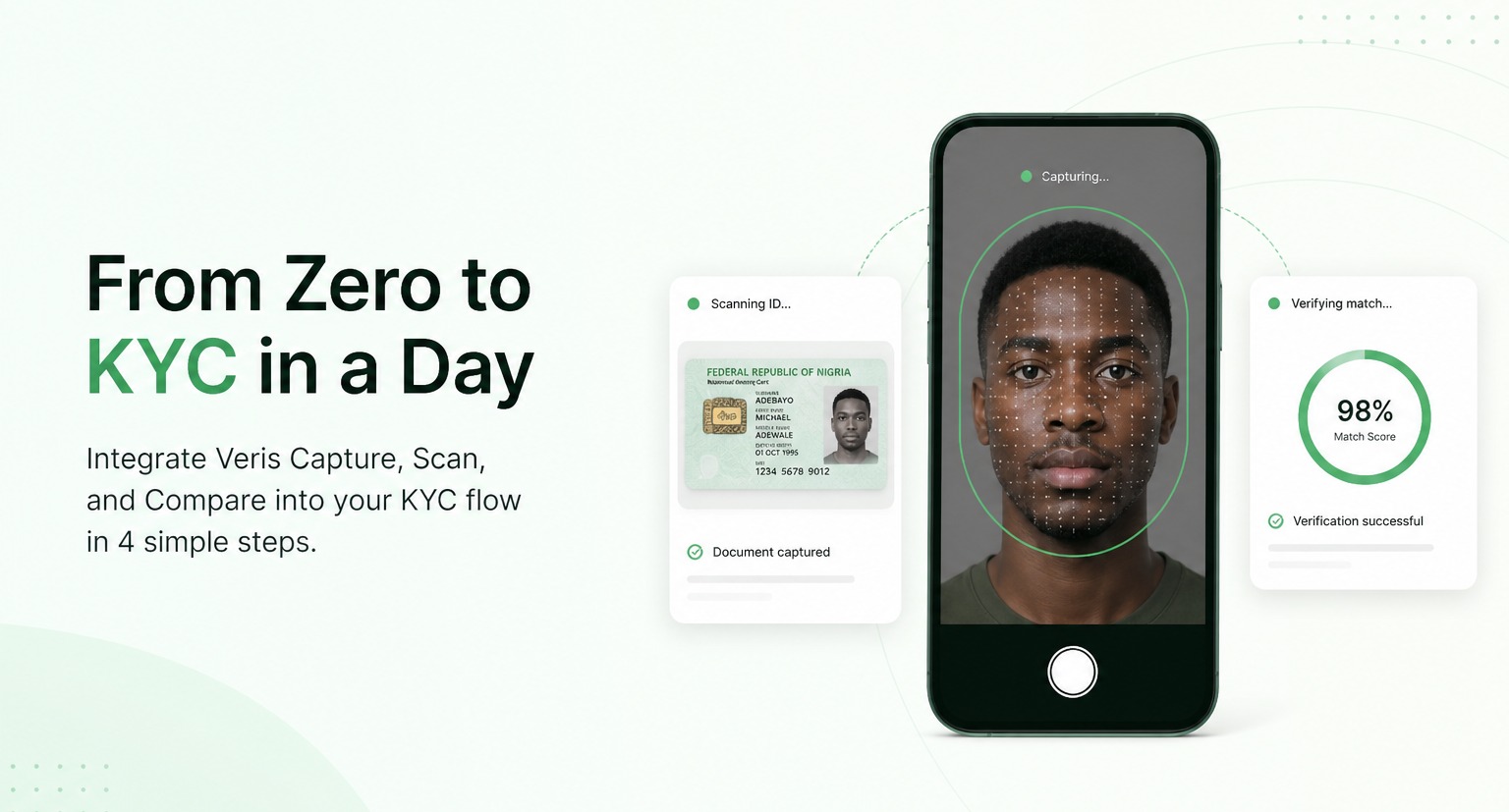
A simple 3 - step flow:
Scan → Selfie → Match
No confusion. No drop-offs caused by friction-heavy steps.
Why This Matters for Nigerian Startups
Tunde’s integration took less than two days. But the real wins were long-term:
Onboarding completion rate jumped from 55% to nearly 85%.
Engineering overhead decreased, no more camera permission bugs, no OCR retraining.
Regulatory anxiety dropped. Every verification comes with a signed audit trail, so when regulators ask, Tunde’s team can produce proof in minutes, not weeks.
When KYC is fast and unobtrusive, users finish signing up. When onboarding completion jumps, your user base, and revenue grows faster.
That’s the difference between surviving a regulatory deadline and thriving because of one.
Try It Yourself
If you’re a Nigerian fintech staring down a KYC deadline, you don’t need to build from scratch. You need tools that understand Nigerian documents, Nigerian networks, and Nigerian realities.
Veris’s sandbox is free. You can test all three products: Capture, Scan, Compare in minutes.
Start building with Veris: https://verisinfra.com
Frequently asked questions
How long does it take to integrate Veris?
A basic capture-and-match flow can be running in a day using the mobile SDKs for capture and the Compare API for matching.
Do I need my own machine-learning infrastructure?
No. Liveness and OCR run on-device, and face matching is a single API call from your backend, so there is no model hosting to manage.
What do I need to start building?
A sandbox key, which you get instantly after verifying your email. Sandbox needs no KYC and gives you full access to all three products.