Introduction
New to identity verification in Nigeria? Start with our complete developer guide.
Product and engineering teams in Nigeria: choose which identity to ask for in one decision, with the CBN rules, the cost and the user experience in mind. BVN, NIN and the voter's card are three different things. This guide explains what each proves, who issues it and how to decide which one your app should verify.
Test the document step now. Create a free account and scan an NIN slip or voter's card in the sandbox. No card needed. Start free
01The three IDs in plain terms
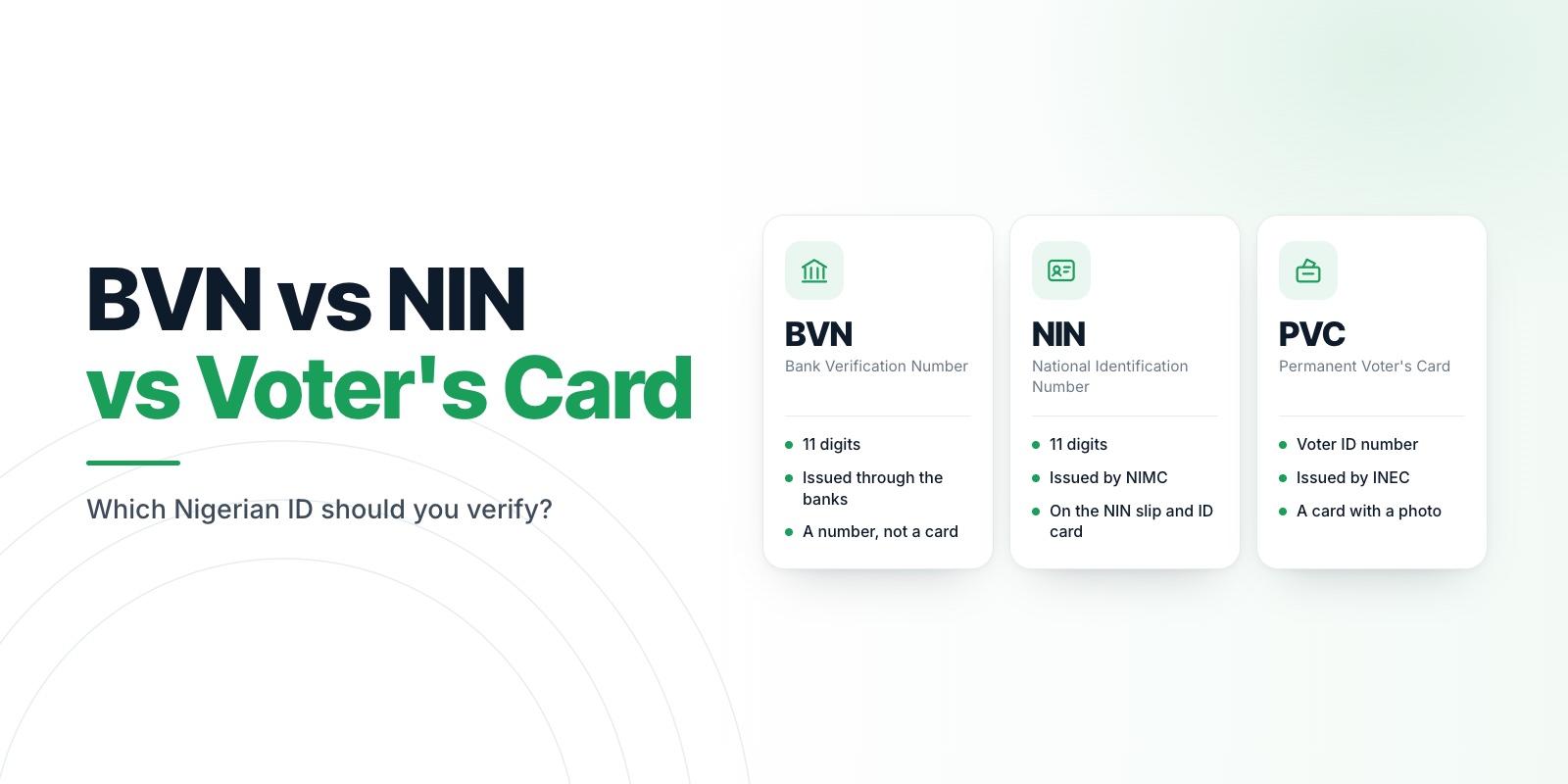
BVN (Bank Verification Number). An 11-digit number issued through the banking system, introduced by the Central Bank of Nigeria in 2014 with the interbank settlement system NIBSS. It ties a person to their bank accounts. It is a number, not a card. There is no BVN document for a user to photograph.
NIN (National Identification Number). An 11-digit number issued by the National Identity Management Commission (NIMC) when a person enrols. It appears on the NIN slip and on the national ID card. It is the national identity record.
Voter's card (PVC). The Permanent Voter's Card issued by INEC. It carries a voter identification number, the holder's details and photo, and where they are registered to vote.
BVN and NIN are both 11 digits but they are separate systems with separate issuers. Do not treat one as a stand-in for the other.
02What the CBN rules say
The CBN's page on the BVN records a December 2023 circular. For individual accounts and wallets, Tier 2 and Tier 3 must have both a BVN and an NIN, and Tier 1 must have a BVN or an NIN. The circular also says onboarding should start by retrieving the BVN or NIN data electronically from the issuing systems.
Rules change, and your licence may add its own conditions. Read the current circular on the CBN's BVN page and ask your compliance officer. For the tier structure, see CBN KYC Requirements: The 3-Tier Framework.
03Reading a document is not looking up a record
This is the point most teams miss, so it deserves its own section.
- Looking up a record means asking the issuing system whether a BVN or NIN exists and who it belongs to. That is a database check.
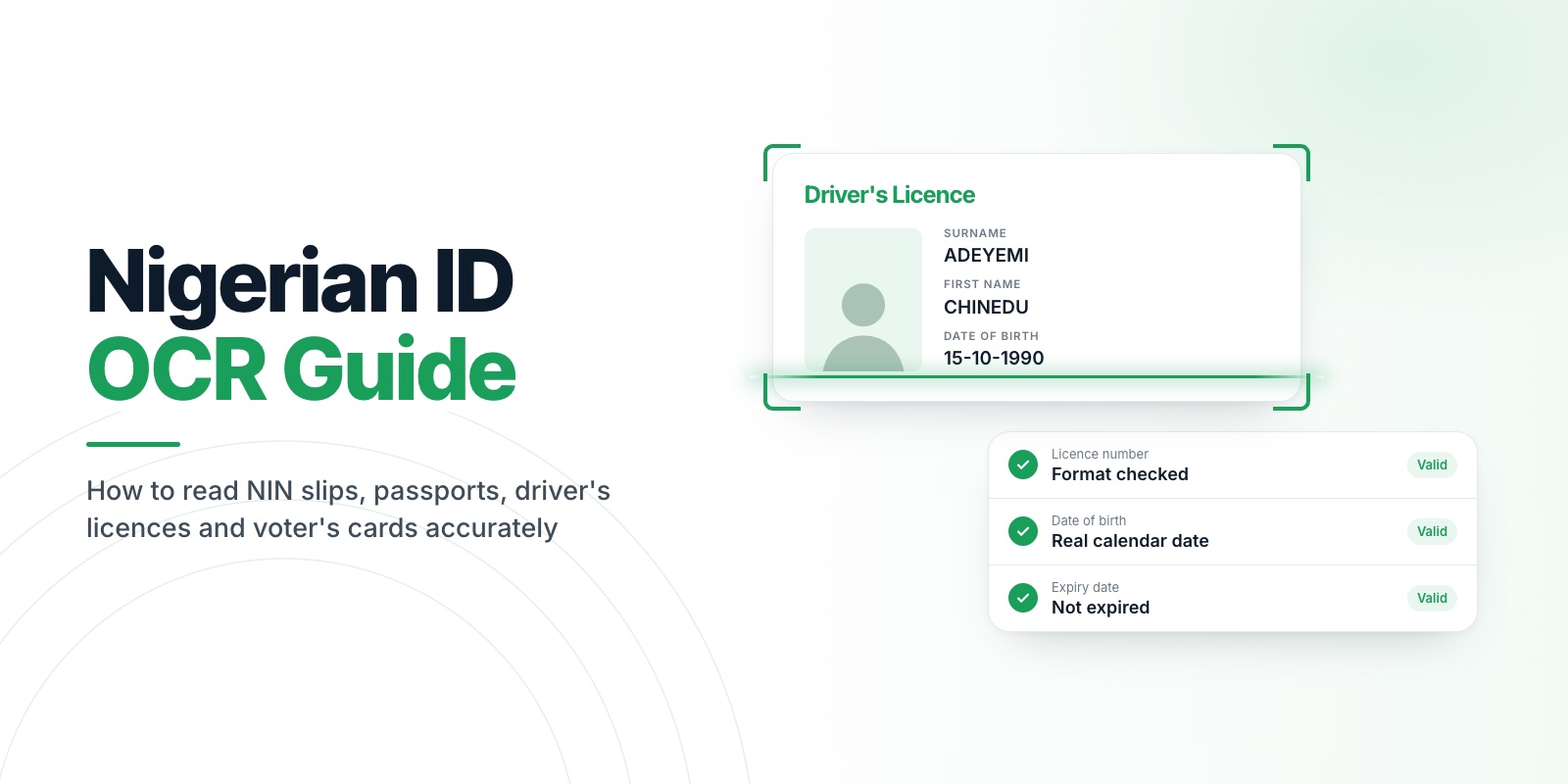
- Reading a document means extracting what is printed on a card or slip, such as the NIN on a NIN slip.
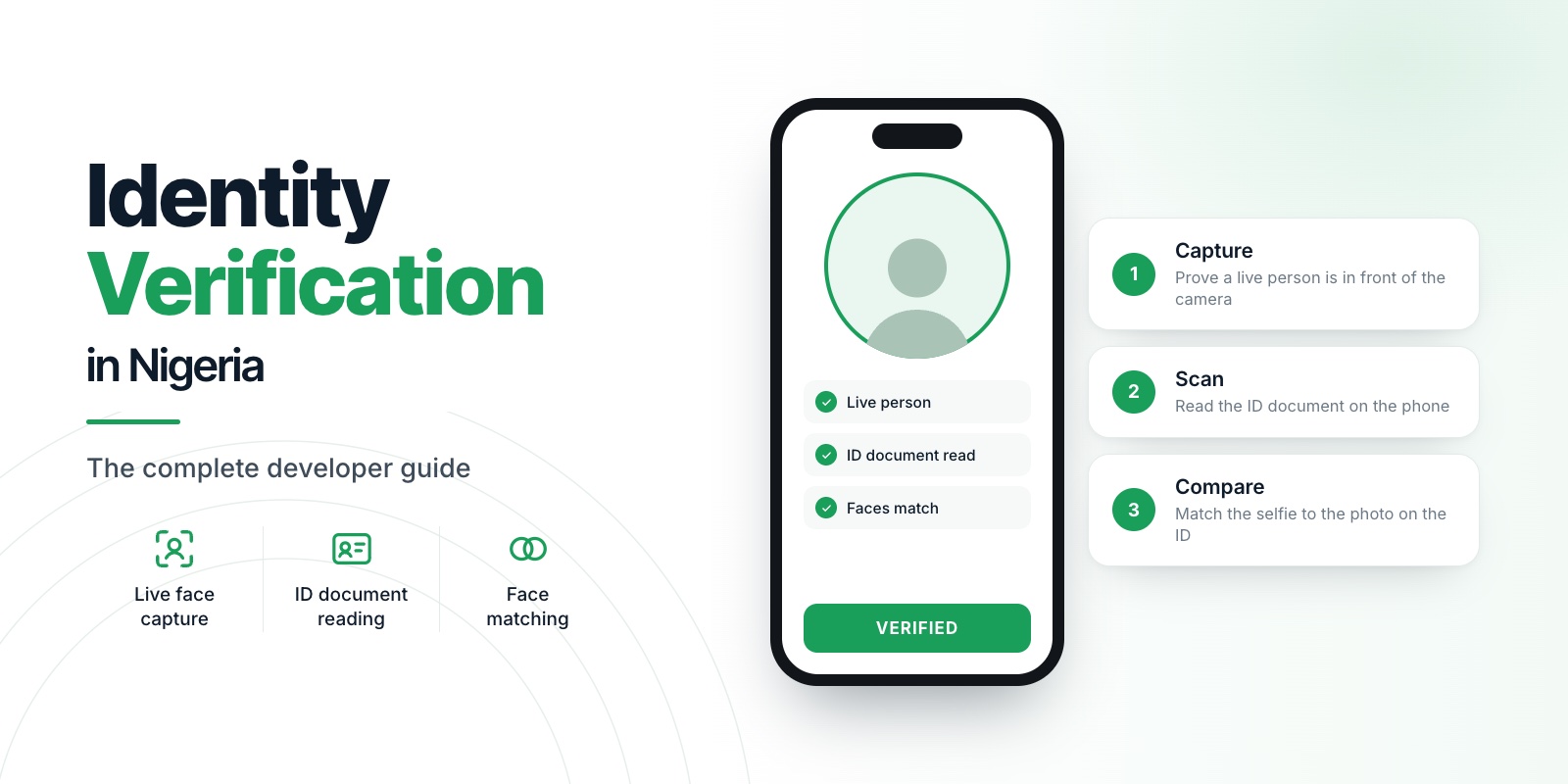
- Matching a face means comparing the live person with the photo on a document.
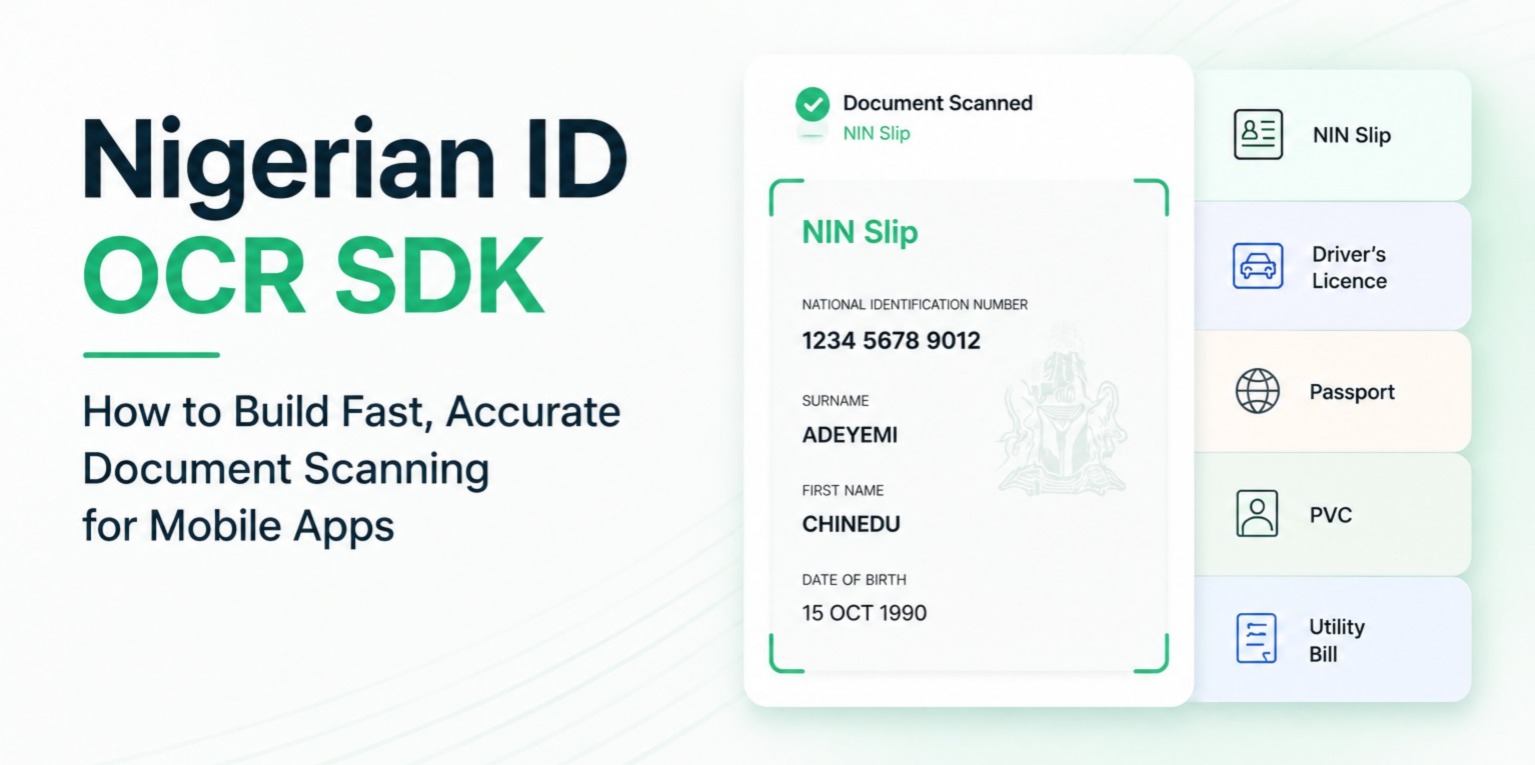
Veris does the second and third. It reads the NIN slip, national ID card and voter's card, and compares faces. It does not look up BVN or NIN records, and there is no BVN document to scan. If your rules require the lookup, run it as a separate step, alongside Veris.
04How to choose
Ask what you need to prove, then pick the ID that proves it.
- "This person is a bank customer." BVN, through a lookup. It is the strongest link to a bank record.
- "This person is who the national record says." NIN, through a lookup, plus a document read to confirm the person has the slip or card.
- "This person is present and matches their ID photo." A document with a photo (NIN card, voter's card, driver's licence or passport), a face photo extracted from it and a live face check.
- "This person lives where they say." A proof-of-address document such as a utility bill. See Utility Bill Verification for KYC.
For most fintech onboarding, the answer is more than one: collect the BVN or NIN number as your regulator requires, and add a live check against the photo on a document so you know the person in front of you is the person on the card.
05Make it easy for the user
- Ask for the fewest things. Each extra ID is a place to lose them.
- Read, do not type. Scanning the NIN slip removes the most common data entry error. See the Nigerian ID OCR guide.
- Explain why. One sentence on why you need it, and that the image stays on the phone, helps.
06What waiting costs you
If you take an NIN or BVN number as text only, you are trusting that the person typing it owns it. Anyone with someone else's number can try. A document read and a live face check close that gap, and every week without them is a week of accounts you cannot fully vouch for.
07What you get with Veris
- NIN slip, national ID card and voter's card read on the phone, with the face photo extracted where one is printed.
- A live face check and a face match against that photo.
- No images stored by Veris, and a flat plan from free: sandbox, then Spark to go live, then Launch at $19 a month for unlimited captures and scans.
08The doubts you probably have
"Do we still need the BVN lookup?" If your rules say so, yes. Veris sits next to it. Use the lookup for the record and Veris for the person.
"Which document do most users have?" It varies, so support more than one and let the user choose. Scan reads nine document types.
"Can we skip the face check if we have the NIN?" An NIN number does not prove the person using the phone owns it. The face check does.
09Your next step
List the IDs your regulator requires and the one extra proof you want that the person is present. Build that in the sandbox this week.
Create your free Veris account · Free to start · no card · all three products.
10FAQ
What is the difference between BVN and NIN?
BVN is an 11-digit number issued through the banking system that links a person to their bank accounts. NIN is an 11-digit number issued by NIMC that identifies a person in the national identity record. They are separate systems.
Do I need both BVN and NIN for onboarding?
It depends on the account tier and your regulator's current rules. The CBN's December 2023 circular requires both for individual Tier 2 and Tier 3 accounts and either for Tier 1. Confirm the current rules for your licence.
Can Veris verify a BVN?
No. Veris does not look up BVN or NIN records, and there is no BVN document to scan. It reads documents such as the NIN slip, and compares faces.
Is the voter's card accepted for KYC?
Acceptance depends on your institution's policy and your regulator's rules for the account tier. Veris can read the voter's card and extract the photo, but your compliance policy decides whether to accept it.